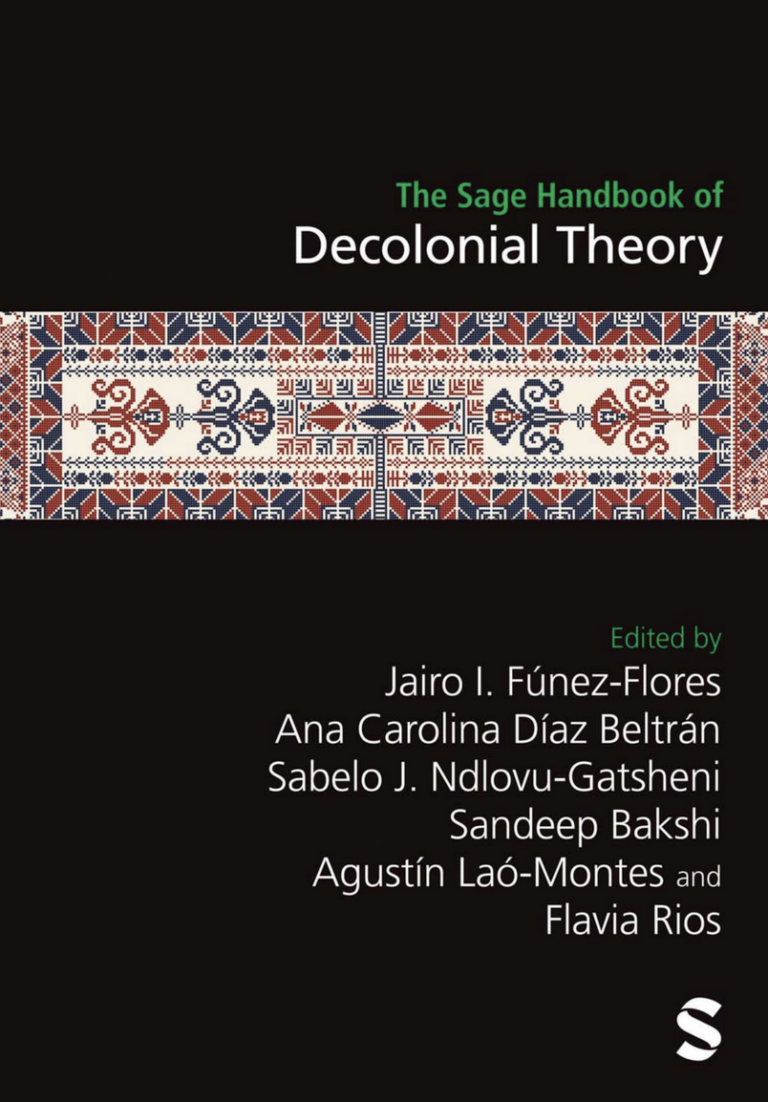
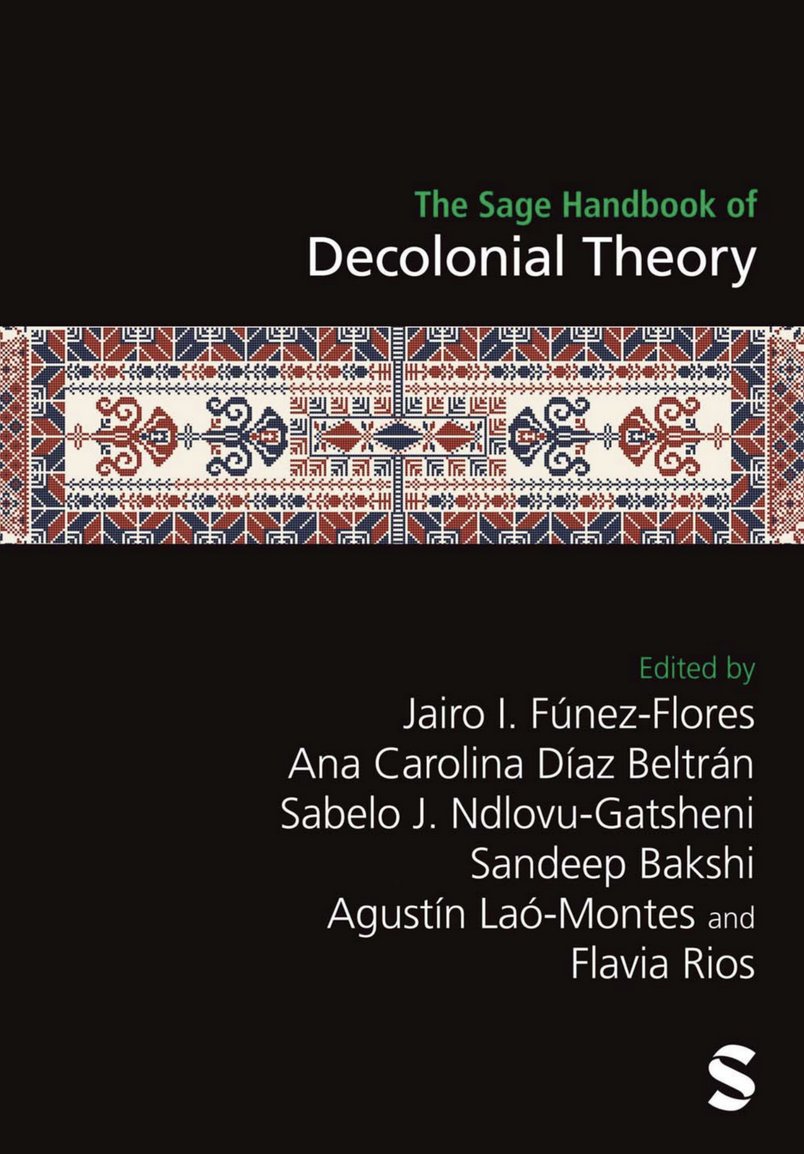
Edited by:
- Jairo I. Fúnez-Flores – Texas Tech University, USA
- Ana Carolina Díaz Beltrán – University of Texas Rio Grande Valley
- Sabelo J. Ndlovu-Gatsheni – University of South Africa
- Sandeep Bakshi – Université Paris Cité
- Augustin Lao-Montes – University of Massachusets, Amherst, USA
- Flavia Rios – Fluminense Federal University, Brazil
The Sage Handbook of Decolonial Theory is a groundbreaking transdisciplinary resource that expands the epistemological and geographical horizons of decolonial thought. This handbook prioritizes the Global South, fostering South-North and South-South inter-epistemic dialogues and situating decolonial thought in sites of struggle. It builds on decolonial thought and praxis from Latin America and the Caribbean, Africa, Asia, and Palestine, among other regions and countries. Addressing the erasure of knowledge production from the Global South in dominant academic spaces, this handbook brings together decolonial scholars and activist intellectuals from the Global South and engages with politically committed scholars in the Global North. It emphasizes the geopolitics and ethics of knowledge production and the importance of situating one’s work in historically excluded regions and communities.
Organized into five parts, the handbook includes conceptual essays and empirical studies on decolonial thought and praxis. It covers a range of topics from (de)coloniality, geopolitics, and transdisciplinarity to decolonial feminisms, gender and sexuality studies, and racial capitalism. The chapters convey a sense of urgency and a committed political voice, demonstrating how decolonial theory can interrogate and intervene in the modern/colonial racial capitalist heteropatriarchal world.
The Sage Handbook of Decolonial Theory is not just for academics; it is written for anyone interested in radical thought and praxis. It recognizes decolonial theory as a plural and dynamic field, concerned with power hierarchies, historiography, and epistemological critiques of Eurocentrism. Ultimately, it teaches us how to think with and act alongside struggles for liberation.
Part I: Key Debates in Decolonial Theory
Part II: Geopolitics and Geographies
Part III: Transdisciplinarity
Part IV: Feminisms, Genders, & Sexualities
Part V: Racial Capitalism
Preview: https://uk.sagepub.com/en-gb/eur/the-sage-handbook-of-decolonial-theory/book286713#preview
All royalties will be donated to Gaza.
Reviews:
The Sage Handbook of Decolonial Theory is a vital and urgent contribution to the ongoing struggles for liberation across the Global South and beyond. This volume resists the erasure of politically grounded knowledge and affirms the epistemic centrality of Indigenous, Black, Latinx, and Palestinian thought and praxis in the fight against racial capitalism, settler colonialism, and heteropatriarchy. As the Palestinian Feminist Collective, we recognize this work as part of a larger struggle to dismantle the structures that sustain oppression and dispossession. We celebrate this Handbook for its commitment to inter-epistemic dialogue, its refusal to accommodate colonial knowledge production, and its insistence on theory as action—rooted in the lived realities of those resisting empire. Everyone engaged in academic organizing must read this book; it is an essential resource for scholars and activists committed to decolonial thought and practice.
This brilliantly conceptualized collection brings together a plurality of differently situated decolonial theories, analyses, empirics, and material practices, around the axes of the coloniality of power, of knowledge, of being, and of gender. It vastly opens up current discussions about relations of power, discourse, material conditions, and the many kinds and dimensions of political resistance, in important new ways. This astonishing transdisciplinary book will become a classic, indeed required reading, for the field.
The Sage Handbook of Decolonial Theory
Editado por:
- Jairo I. Fúnez-Flores – Universidad de Texas Tech, EE. UU.
- Ana Carolina Díaz Beltrán – Universidad de Texas Rio Grande Valley, EE. UU.
- Sabelo J. Ndlovu-Gatsheni – Universidad de Sudáfrica
- Sandeep Bakshi – Universidad de París Cité, Francia
- Augustin Lao-Montes – Universidad de Massachusetts Amherst, EE. UU.
- Flavia Rios – Universidad Federal Fluminense, Brasil
Agosto 2025 | 704 páginas | SAGE Publications Ltd
Acaba de publicarse “The Sage Handbook of Decolonial Theory”, un recurso transdisciplinario que amplía los horizontes epistemológicos y geográficos del pensamiento decolonial. El libro se basa en el pensamiento y la praxis decolonial de América Latina y el Caribe, África, Asia y Palestina, entre otras regiones y países. Fomentando diálogos inter-epistémicos Sur-Norte y Sur-Sur, sitúa la reflexión decolonial en espacios de lucha.
Tjasa Kancler (Sección del Arte y Cultura Visual, Departamento de Artes Visuales y Diseño, BBAA, UB) y Piro Rexhepi (School of Slavonic & East European Studies, UCL) participan con el capítulo “Decolonialidad en/y Europa del Este”, analizando el contexto turbo-capitalista post-Guerra Fría, la necropolítica migratoria de la UE y los procesos de zonificación en relación a los desafíos decoloniales en discursos teóricos, prácticas activistas y artísticas en Europa del Este. El texto aborda críticamente el borrado de los análisis marxistas negros del capitalismo racial en la Opción Decolonial así como la repetición de políticas capitalistas coloniales occidentales y procesos de racialización históricos/actuales en la región, para re-conectar las luchas anticoloniales con geografías de liberación más amplias.
Organizado en cinco partes, The Sage Handbook of Decolonial Theory incluye ensayos conceptuales y estudios empíricos de investigadorxs, pensadorxs y activistas decoloniales del Sur Global, estableciendo diálogo con investigadorxs políticamente comprometidos del Norte Global. El libro abarca cuestiones en torno a (de)colonialidad, geopolítica, crítica del eurocentrismo, transdisciplinariedad, feminismos decoloniales, estudios de género y sexualidad, y capitalismo racial. Los capítulos transmiten un sentido de urgencia y una voz política comprometida demostrando cómo la teoría y la praxis decolonial pueden cuestionar e intervenir en el mundo moderno/colonial, racial, capitalista y cisheteropatriarcal.
Todas las regalías serán donadas a Gaza.
Más información: https://us.sagepub.com/en-us/nam/the-sage-handbook-of-decolonial-theory/book286713#preview